ProductsPet Wellbeing Kidney Support Gold for Cats
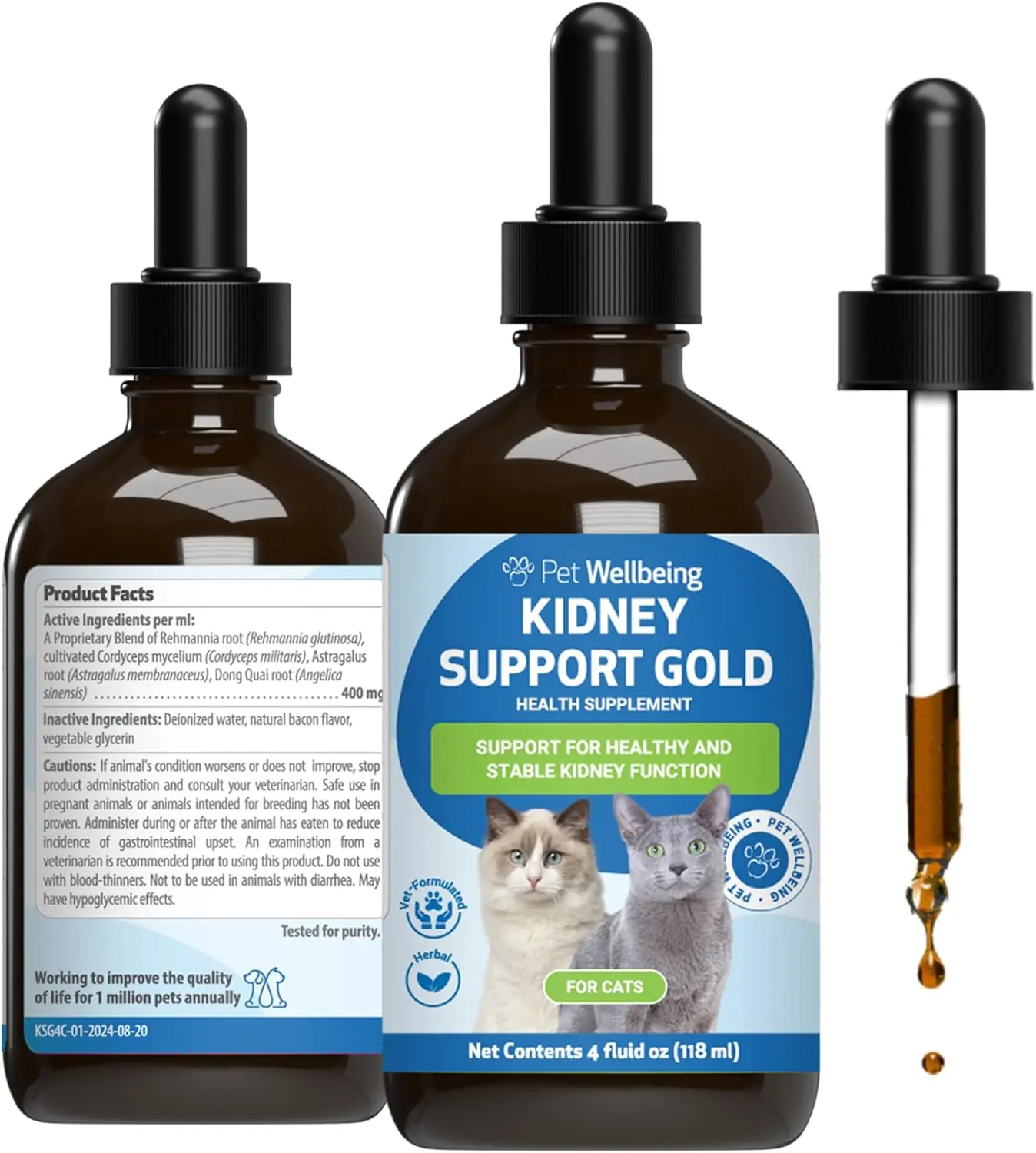
Pet Wellbeing Kidney Support Gold for Cats
Updated October 25, 2026 | 194 views
What it is and what it claims to do
Kidney Support Gold is a liquid herbal supplement marketed for the long-term support of “normal renal function” in cats. The manufacturer makes claims regarding the maintenance of healthy thirst and urination levels, fluid and electrolyte balance, appetite and weight, immune support, and overall vitality.
Formula and label transparency
Active ingredients listed
- Rehmannia root (Rehmannia glutinosa)
- Cordyceps mycelium (Cordyceps militaris)
- Astragalus root (Astragalus membranaceus)
- Dong quai root (Angelica sinensis)
Concentration and what is missing The label indicates a concentration of 400 mg per ml, but it uses a "proprietary blend," meaning it does not break down exactly how much of each individual herb is present in a dose. This lack of transparency limits precision when a professional is trying to evaluate efficacy, potential drug interactions, and specific risks for a medically complex CKD patient.
Inactive ingredients Deionized water, natural bacon flavor, and vegetable glycerin.
Dosing directions on the product page
The standard protocol
- 10 lb and under: 0.25 ml twice daily
- Over 10 lb: 0.5 ml twice daily
- The "Double" Rule: If no change is seen after 2 weeks, the manufacturer states you may double the daily amount.
- Administration: Give during or after meals; shake well; refrigeration is not required.
Clinical Reality I would be extremely cautious about doubling the dose without direct veterinary input. This is especially true for cats on multiple medications or those struggling with borderline blood pressure, anemia, nausea, or heart disease.
Safety cautions you should take seriously
The manufacturer lists several critical cautions
- Stop and consult your veterinarian if the condition worsens or does not improve.
- Not proven safe in pregnant or breeding animals.
- Give with food to reduce the risk of GI upset.
- Do not use with blood thinners.
- Not to be used in animals with diarrhea.
- May have hypoglycemic (blood sugar lowering) effects.
The Prop 65 Warning This product displays a California Proposition 65 warning stating it can expose your pet to chemicals including lead. While these warnings are common, CKD cats have less physiologic margin for toxins. This makes a conversation with your vet even more vital.
Ingredient by ingredient: value and real-world caveats
Cordyceps militaris (mycelium) There is preclinical and some human literature suggesting renal protective signals in certain CKD contexts, often via antioxidant and anti-inflammatory pathways. However, this is not feline-specific, and the exact dose equivalence for a cat remains unknown.
Astragalus membranaceus Astragalus has a sizable body of literature in human CKD and diabetic kidney disease, with some studies suggesting improved outcomes. Again, cat-specific data is lacking, and the preparation (extract type and purity) matters enormously for safety.
Dong quai (Angelica sinensis) This ingredient is the primary source of interaction concerns. Dong quai has a documented risk of interacting with anticoagulants (like warfarin), increasing bleeding risk. Even though cats aren't usually on warfarin, many CKD cats are on antiplatelet therapy (like clopidogrel) or have concurrent diseases where bleeding is a risk.
Rehmannia Associated with hypoglycemic effects in humans, which explains the product's own caution. If your cat is diabetic or has a poor appetite, your vet must guide the use of this herb to avoid dangerous blood sugar drops.
Does it “work” for CKD cats?
I would frame this as an adjunct that may help some cats feel better, often by supporting appetite or vitality, but it is not a substitute for the evidence-based pillars of CKD care:
- Renal diet strategy
- Phosphorus control (diet and binders)
- Blood pressure and proteinuria management
- Hydration plans (like Sub-Q fluids)
- Nausea and appetite support
A Note on Lab Values Any supplement claiming to "promote normal BUN and creatinine" should be interpreted carefully. In CKD, these values change for many reasons (hydration, muscle mass, diet). A cat can feel better without the labs changing, and labs can improve without the disease actually being "cured."
Who should avoid this (or use only with a vet)
- Cats on any anticoagulant or antiplatelet medication (e.g., Clopidogrel/Plavix).
- Diabetic cats or those with inconsistent eating habits.
- Cats with chronic diarrhea, IBD flares, or significant GI sensitivity.
- Cats with complex medication lists for multiple diseases.
- Any cat with advanced CKD that is clinically unstable (vomiting, dehydrated, lethargic).
Practical way to trial it safely
Consult Bring the full medication list to your vet and ask specifically about bleeding and glucose risks.
Start Low Begin at the labeled dose, always given with food.
Track Daily Monitor appetite, water intake, urine clumps, energy, and stool quality.
Watch for Red Flags Stop and call the vet if you see new diarrhea, bruising, nose/gum bleeding, or marked lethargy.
Monitor Labs Recheck bloodwork and blood pressure on your usual schedule; don't rely solely on how the cat "seems."
What Other Users Are Saying
User experiences generally fall into two extreme camps: those who see a "quality of life" turnaround and those who struggle with palatability or GI side effects.
The Good: "The rebound effect"
-
Appetite restoration: The most frequently reported positive outcome is a significant improvement in appetite. Many owners of senior CKD cats describe their pets going from "picky/refusing food" to eating full meals within 3-5 days of starting the supplement.
-
"De-aging" behavior: A common theme in positive reviews is the return of vitality. Owners often use phrases like "acting like a kitten again," "coat looks better," or "engaging with the family" after months of lethargy.
-
Stabilization (not cure): Experienced CKD owners often note that while their cat's blood values (BUN/Creatinine) didn't necessarily drop dramatically, they stopped getting worse (stabilized) while on the product, which many consider a win.
The Bad: Palatability and GI issues
-
The "Bacon Flavor" struggle: Despite the flavoring, a significant number of cats reject this supplement. Owners report that once mixed into food, some cats will refuse to eat the entire bowl, which is dangerous for a CKD cat who cannot afford to skip meals.
-
User Tip: Many successful users bypass the food bowl entirely and syringe it directly into the cat's mouth or mix it with a high-value treat like Churu/squeeze treats to ensure consumption.
-
-
Vomiting & Diarrhea: There is a minority but consistent pattern of users reporting increased vomiting or loose stools shortly after starting. This seems to be more common in cats with sensitive stomachs or late-stage CKD.
The Controversial: Formula changes & Safety
-
Consistency variations: Recent discussions (late 2024–2025) mention inconsistent bottle quality, with some repeat buyers noting the liquid becoming "watery" or the dropper design changing, leading to confusion about whether the formula potency has changed.
-
The "Seizure" Anecdote: There are rare but serious anecdotal reports (specifically on Reddit) of pets suffering seizures or rapid decline immediately after administration. While impossible to link definitively without a necropsy, these stories underscore the importance of not using this in unstable cats without vet approval.
-
Vet Pushback: Some users report their veterinarians were skeptical or advised against it due to the Prop 65 lead warning or the lack of ingredient clarity, preferring prescribed phosphate binders or standard medical management instead.
Bottom line recommendation
Kidney Support Gold is a thoughtfully marketed herbal blend with some biologic plausibility, but it has meaningful limitations: unclear dosing for individual herbs, interaction flags, and a lead warning. I consider it a "may help" addition for some cats, not a core therapy.
Disclaimer: This content is for educational purposes only and does not constitute veterinary medical advice. Supplements are not regulated by the FDA to the same standards as pharmaceuticals; "natural" does not mean "safe," and ingredients or potency can vary between batches. Always consult with your primary care veterinarian or a veterinary internal medicine specialist regarding your cat’s specific condition and potential interactions with prescribed medications.